
Training Your Puppy
Getting a puppy is an exciting time for everyone in the family, but your puppy’s early training and socialisation is important so that he grows up to be a well-mannered and well-adjusted dog. Consistency is key, but it should be fun for everyone too!
Here is some simple early training, along with some general training rules, that can be started as soon as you pick your puppy up from the breeder…
- Make a point of handling your puppy all over on a regular basis. Gently check inside his ears, look at his teeth, paws legs and tail. This is a great opportunity for bonding with your new puppy, and will also make life easier at any future visits to the vet.
- Teach your puppy his name. Have him on a loose lead and call your dog’s name in a normal voice. As soon as he looks at you reward him with a treat. Repeat until he responds quickly.
- Teach your puppy to sit. Using a treat, move it from just in front of his nose to just above his head. As soon as he sits reward him with the treat. Practise this as often as possible in as many different places as possible!
- Teach your puppy to lie down. Using a treat, hold it just in front of your dog’s nose to the floor. As soon as he gets it right reward him by giving him the treat.
- Teach your puppy to touch your hand. Bring your hand close to your puppy’s nose and as soon as he touches it reward him with a treat.
- Teach your puppy to stand. Using a treat held near your puppy’s nose, guide him into position. Reward him when he gets it right, and you might find it helpful to reward him for every step he takes in the right direction.
- Teach your puppy to walk on a loose lead. Reward your puppy with a treat when he follows you. Start with a small number of steps and gradually increase it. Don’t forget to practise this in different environments as it’s a valuable life skill for every dog!
- Teach your puppy to greet people appropriately. Not everyone likes to have a dog jump up at them, especially a muddy one! The best way to teach this is to get your puppy to do something else, for example getting him to sit when he meets someone. This also allows your visitor to give your puppy a treat to reward him.
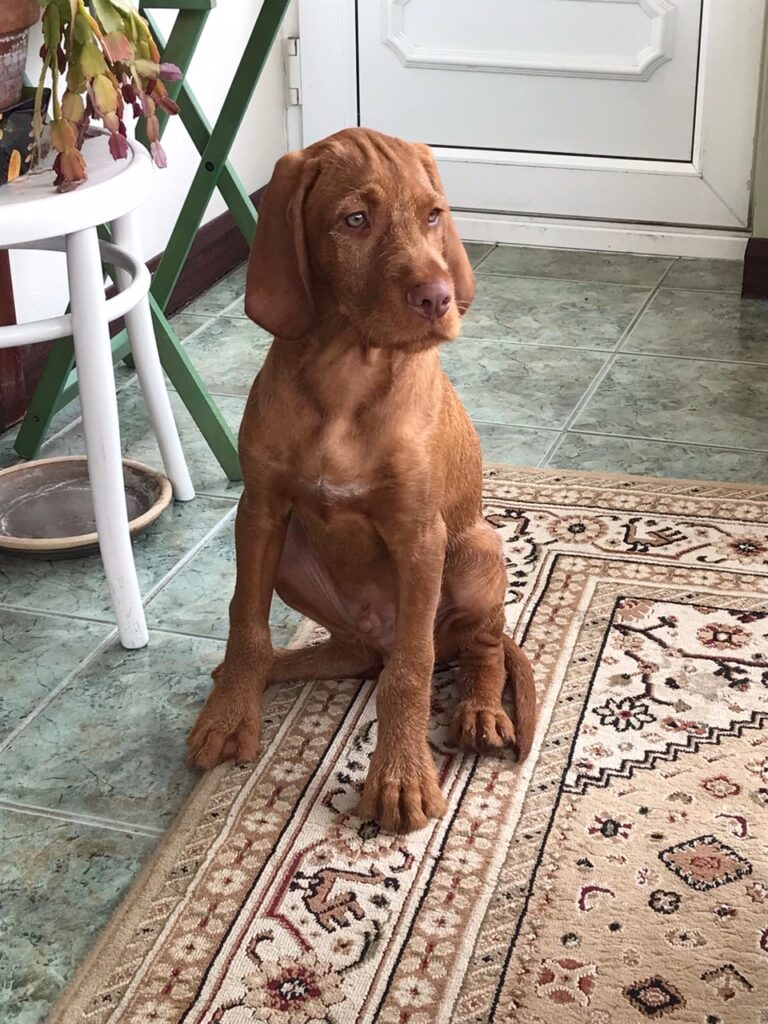

General training rules
- Don’t train your puppy if you are in a bad mood, it’s unlikely to go well!
- Be consistent to give your puppy the best chance of success. Choose your words for various actions and ask your family to use the same ones.
- Use high value treats, especially for recall work!
- Use a cheerful, happy voice.
- Practise in many different situations and locations. Start off in an easy location, such as indoors, and only progress to harder locations with more distractions when your puppy is consistently getting it right.
- Only increase the level of difficulty when your puppy is ready – don’t allow him to make mistakes by pushing him too fast.
- Always keep your puppy within a reasonable distance. All dogs have a certain distance at which they are controllable and respond to commands. Work out what this distance is for your puppy.
- Make it fun! We all learn better when the lessons are enjoyable.
- Don’t over work your puppy. Short and sweet sessions and teaching an exercise step by step are much better to achieve positive results.
- Keep your puppy safe! Choose your training locations wisely and have him under control at all times. Your puppy’s safety must be top priority.
Trouble Shooting
There will always be times when you think your puppy has learnt an exercise at home and he does it well, only to ignore you when you get to the park! This usually means that there is a gap in his training, so these three simple steps will help you to help your puppy get it right, even in the park.
Make sure you have taught the exercise – short sessions, teaching step by step, use rewards and make sure your puppy understands. These are the building blocks of teaching your puppy something new.
The next thing you need to do to ensure your puppy even responds to you in the park is to generalise the exercise. Make sure that you practise in lots of different locations and situations so that he can adapt to the exercise and recall the information regardless of where he is.